Cybersecurity isn’t a single lane, and it definitely isn’t summed up by one job title. Some folks like getting their hands dirty in testing, poking at systems, and spotting weak points before anyone with bad intent gets there first.
Others are more comfortable on the defensive side, keeping networks steady, protecting services, and shutting problems down before they snowball.
Then there are the people who gravitate toward the “what just happened?” part of the work, investigations, incident response, and piecing together the story after an incident.
On top of that, the field is full of specialized roles: SOC work and alert triage, risk and compliance, security management and leadership, cloud security, application security, and, increasingly, AI security too.
That’s also why EC-Council can feel a little overwhelming at the start. Their catalog is wide. CEH is the one most people recognize, but it’s only a slice of what they offer.
Depending on what you’re trying to do, EC-Council has different tracks aimed at ethical hacking, network defense, forensics, incident handling, cloud, application security, AI-focused security, plus leadership.
Below, this article lays out the main EC-Council directions in plain language, so it’s easier to see what matches your current role, what you want next, and where you might go from here in cybersecurity.
If you want the complete rundown, course names, levels, subject coverage, and training formats, the EC-Council board page on BilduX is a useful place to look.
What is the EC-Council?
EC-Council is a training and certification body focused on cybersecurity.
The organization’s formal name is the International Council of E-Commerce Consultants, though most people recognize it by its credentials, for example CEH, CND, CHFI, CPENT, and CCISO.
Its catalog stretches across a wide slice of security work: ethical hacking, network defense, digital forensics, incident response, SOC operations, cloud and application security, along with management and leadership tracks.
In other words, EC-Council isn’t a single class or a one-lane career route. It’s a larger set of certifications aimed at different jobs in the field.
Is EC-Council a legitimate certification?
Yes. EC-Council is considered a legitimate certification issuer.
A number of its certifications hold ISO/IEC 17024 accreditation through ANAB (the ANSI National Accreditation Board), including CEH, CPENT, CND, CHFI, ECIH, CCT, and CCISO.Still, legitimacy doesn’t automatically make every credential a good fit.
What it does tell you is that the organization, and several of its programs, have formal recognition.
The more useful question is practical: does the particular EC-Council certification match your current role, what your employer wants to see, what you can spend, and the security direction you’re trying to move toward?
Which EC-Council certification is best?
The Problem Is Not Finding a Cybersecurity Course
There are many cybersecurity courses.
The harder part is choosing the right one for the work you want to do.
CEH is popular, but not every cybersecurity learner needs ethical hacking first. Some people need network defense. Some need forensics. Some need SOC skills. Some need incident response. Others need leadership and governance.
This is why the better question is not “Which EC-Council certification is best?”
It is “Which cybersecurity role am I preparing for?”
Which EC Council certification is best?
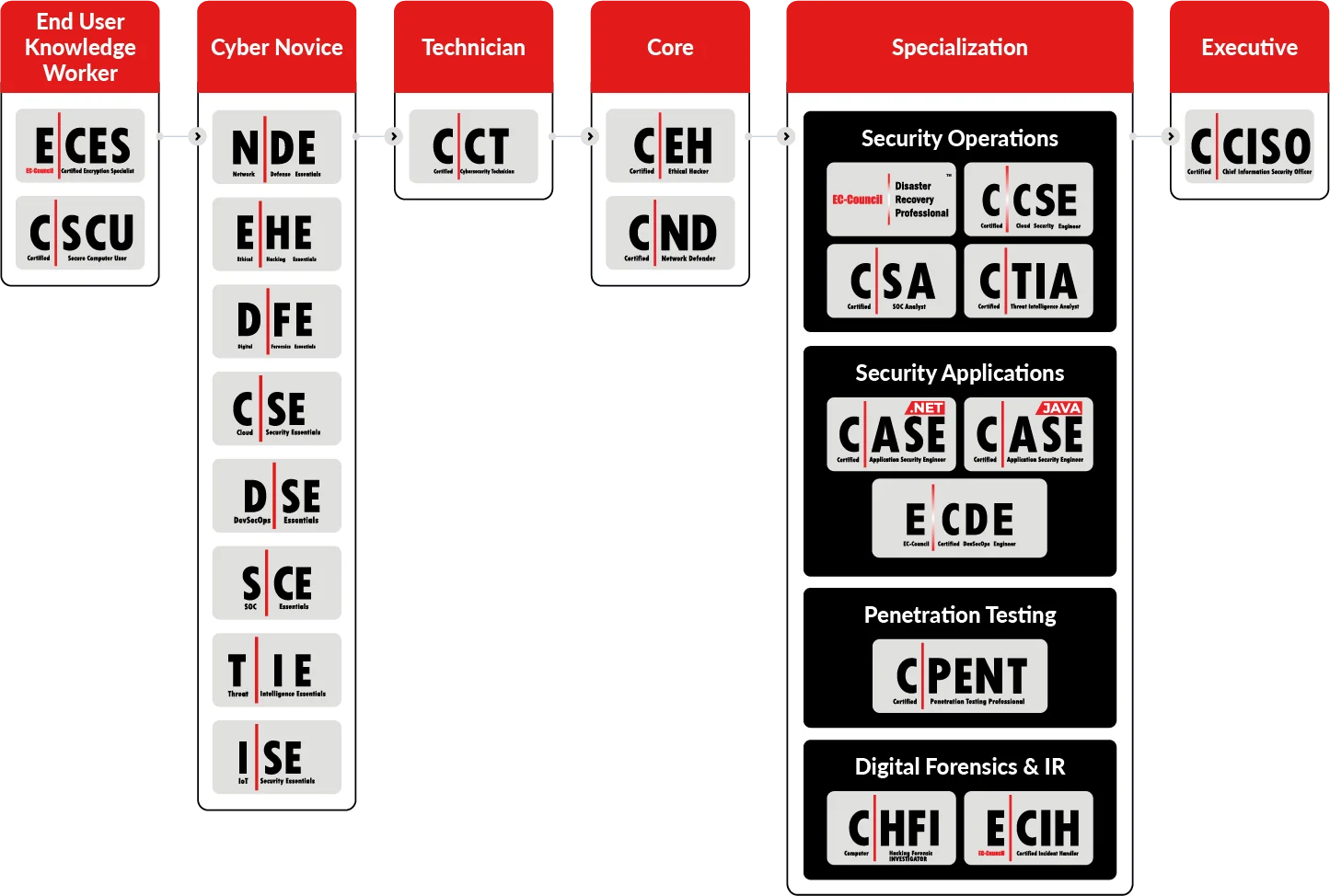
EC-Council Is More Than CEH
Many people hear EC-Council and think of CEH first.
That makes sense, because CEH is one of the best-known names in ethical hacking. But EC-Council covers more than one cybersecurity path.
Ethical Hacking
CEH fits people who want to understand attacker methods in a legal and structured way.
It helps learners see how weaknesses are found, tested, and explained before real attackers use them.
Penetration Testing
CPENT fits people who want a more advanced and hands-on testing path.
This direction is closer to practical penetration testing work, where learners need to apply skills in more complex situations.
Network Defense
CND fits people who want to protect networks, systems, and infrastructure.
This path is more focused on defense, monitoring, and keeping environments safer.
Digital Forensics
CHFI fits people who want to investigate incidents.
It helps learners understand what happened after an attack and how digital evidence can support an investigation.
SOC and Incident Response
CSA and ECIH fit people who work with alerts, incidents, and daily security operations.
This direction is useful for learners who want to monitor threats, respond to events, and support a security team.
Threat Intelligence
CTIA fits people who want to understand threats before they become bigger problems.
It focuses on attacker behavior, security data, and threat information.
Application and Cloud Security
CASE.Net, CASE Java, WAHS, CCSE, and related paths fit people who work close to software, web apps, cloud systems, and secure development.
This direction is useful when security needs to be part of how systems are built, tested, deployed, and protected.
Leadership and Governance
CCISO and Associate CCISO fit people who connect cybersecurity with risk, budget, governance, and business decisions.
This path is less about doing every technical task yourself and more about leading security work in a clear and responsible way.
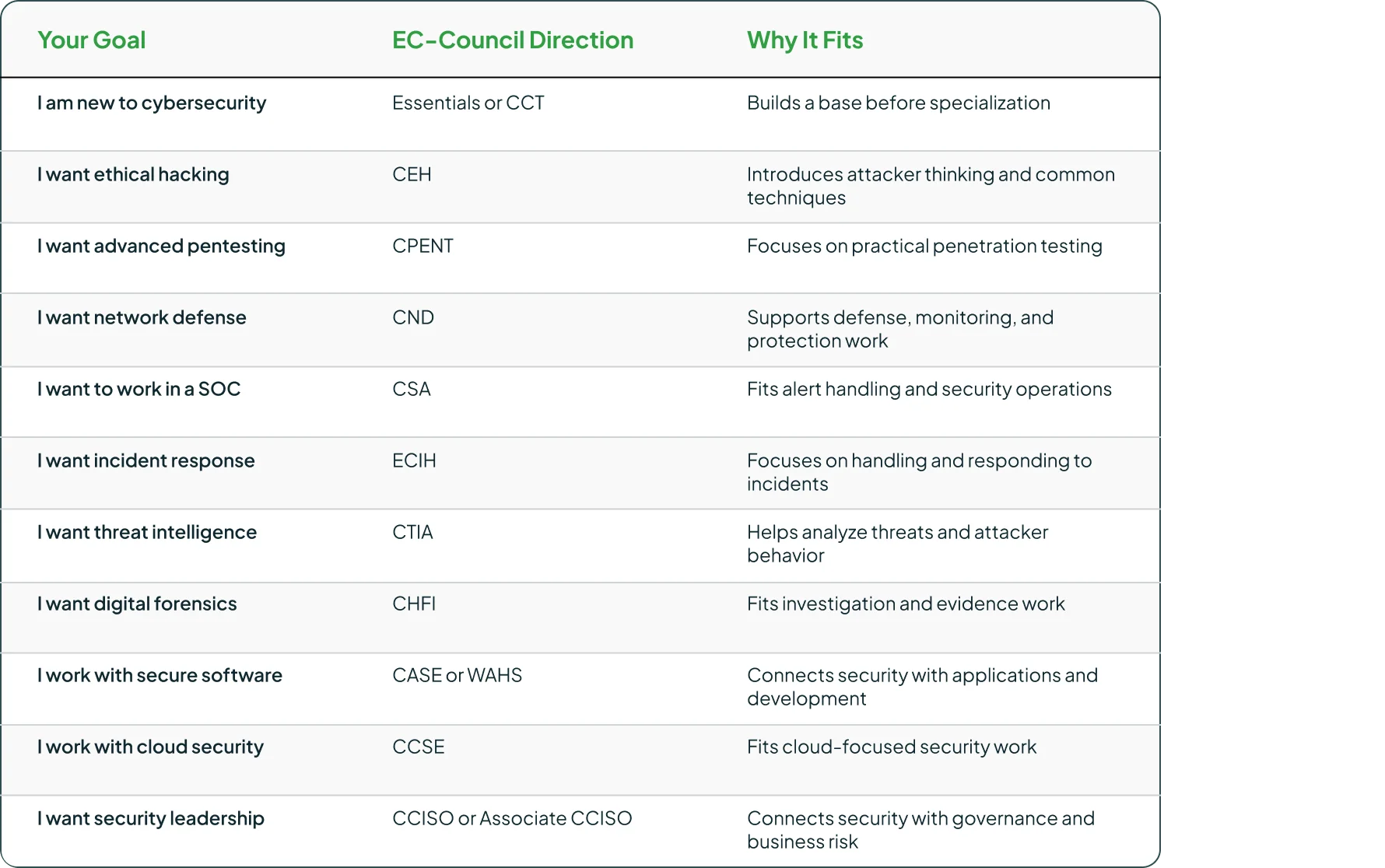
Which EC-Council Direction Fits Your Cybersecurity Goal?
A certification path becomes easier to choose when you start with the work you want to do.
CompTIA or EC-Council?
CompTIA and EC-Council can both support a cybersecurity career, but they are not the same kind of path.
CompTIA is often a good choice when you want a broad IT and security base. It can help learners build foundations in systems, networks, security, cloud, analysis, and testing.
EC-Council is more focused on cybersecurity roles. It is useful when you already know the direction you want, such as ethical hacking, network defense, forensics, SOC work, incident response, cloud security, or security leadership.
Choose CompTIA if you need a wider technical base before specializing.
Choose EC-Council if you want a more role-based cybersecurity path and a certification that matches a specific security job direction.
For many learners, the choice is not “one or the other.” CompTIA can build the foundation, and EC-Council can support the next cybersecurity specialization.
Common Mistakes When Choosing an EC-Council Certification
Because EC-Council offers so many tracks in cybersecurity, it’s easy to rush the decision and pick something fast.
A smarter move is to line up the certification with what you already know, the role you’re aiming for, and the type of security work you actually want to spend your time doing.
Choosing CEH Only Because It Is Famous
CEH has a big name, no doubt, but that doesn’t automatically make it the best fit for every path in cybersecurity. It’s a solid match for ethical hacking goals, yet plenty of people are better served by training in defense, forensics, SOC work, cloud security, or even leadership, depending on where they’re headed.
Choosing Advanced Training Too Early
Advanced courses can pay off, but only when the basics are already steady.
Before jumping into an advanced track, it helps to be comfortable with systems and networks, core security ideas, common tools, and the kind of hands-on problem solving that shows up in real work.
Ignoring Defensive Roles
Pen testing isn’t the only “real” cybersecurity career, and not everyone needs to become a penetration tester.
Network defense, SOC operations, incident response, threat intelligence, and digital forensics are all strong directions with plenty of demand.
Forgetting Hands-On Practice
A certification can give your learning a clear structure, but skill doesn’t come from reading alone.
You need labs, tool time, testing and investigation practice, and real troubleshooting. Without that, progress tends to stall.
Not Checking Job Requirements
Some employers look for particular certifications, while others focus more on what you can do, experience, technical depth, labs, projects, and proof you’ve built things or solved problems. Before committing to a course, it’s worth scanning real job postings for the role you want and seeing what shows up again and again.
Top 5 Questions About EC-Council
Is EC-Council only about ethical hacking?
No. CEH is the best-known EC-Council certification, but it’s only one part of the catalog.
EC-Council also includes training tied to network defense, digital forensics, SOC operations, incident response, threat intelligence, application security, cloud security, technician-level skills, and security leadership.
Is CEH worth it?
That depends on what you’re trying to get out of it.
CEH can be a good choice if you want a structured ethical hacking route, or if employers in your target job market recognize it and ask for it.
Still, it shouldn’t be chosen just for the name, compare it against your role goals, your budget, and the amount of hands-on practice you need.
Is CEH enough to get a job?
It can strengthen your profile, but it usually won’t carry you by itself.
Most cybersecurity roles expect a mix: certification plus technical knowledge, labs, tools, projects, and evidence you can solve practical problems.
CEH can signal ethical hacking knowledge, but you’ll still want solid, visible proof of real skills.
Is EC-Council recognized?
Yes. EC-Council is a recognized provider in cybersecurity certifications.
Several certifications are accredited under the ISO/IEC 17024 standard through ANAB. Those include CEH, CEH Practical, CPENT, CND, CHFI, ECIH, CCT, and CCISO.
Which EC-Council certification should I choose first?
Start with where you are now and where you want to go.
If you’re new to cybersecurity, a foundation or technician-level option often makes more sense as a first step. If ethical hacking is your target, CEH might be the right direction.
If you’re leaning toward defense, CND can be a better match. If you want to focus on forensics, CHFI lines up more closely. If leadership is the aim, CCISO fits that track.
In the end, the “best” EC-Council certification is simply the one that matches the work you want to do.