


Bildux Logo
iSAQB® Promo

iSAQB® CPSA: Certified Professional for Software Architecture

  • 21 Trainings
  • 1 Provider

iSAQB (International Software Architecture Qualification Board) provides a structured certification path for software architects through the Certified Professional for Software Architecture (CPSA) program. It includes the CPSA-F (Foundation Level) and CPSA-A (Advanced Level), focusing on practical architecture skills, terminology, documentation, and decision-making.

On Bildux, you can compare training courses from different providers that align with iSAQB curricula, including exam preparation options and Advanced Level module coverage. This board helps individuals and HR or L&D teams identify training that fits role needs and development plans.

iSAQB® Course Catalogue

21 courses

iSAQB® CPSA-A

20 courses

(Advanced Level)

Inhouse Training

Train your entire team

Submit one request and let verified providers compete with their best offers. Compare side by side, pick the perfect fit.

Verified providersCompetitive pricingFlexible scheduling
Request Inhouse Training
Inhouse Training

iSAQB® (International Software Architecture Qualification Board)

1

iSAQB® CPSA-F(Foundation Level)

iSAQB® CPSA-F (Foundation Level)

The iSAQB CPSA-F (Foundation Level) covers the core knowledge needed to design and document software architectures for systems up to a medium size. It focuses on basic architecture concepts, requirements and constraints, design and development, specification and communication, and analysis and assessment. This level is aimed at developers and aspiring architects who want a shared vocabulary and practical methods for architecture work in a team, including quality evaluation and the use of common tools. Prior software development experience is recommended.

CPSA-F is the entry level of the iSAQB Certified Professional for Software Architecture program. The Foundation Level curriculum covers the core knowledge many software architects use in day-to-day work, including:

  • Basic concepts of software architecture, including the role and tasks of software architects

  • Requirements and constraints as a basis for architectural work

  • Design and development of software architectures, especially for small to medium-sized systems

  • Specification and communication, including describing and documenting architectures

  • Analysis and assessment, including architecture and quality evaluation

  • Examples of software architectures

2

iSAQB® CPSA-A (Advanced Level)

iSAQB® CPSA-A  (Advanced Level)

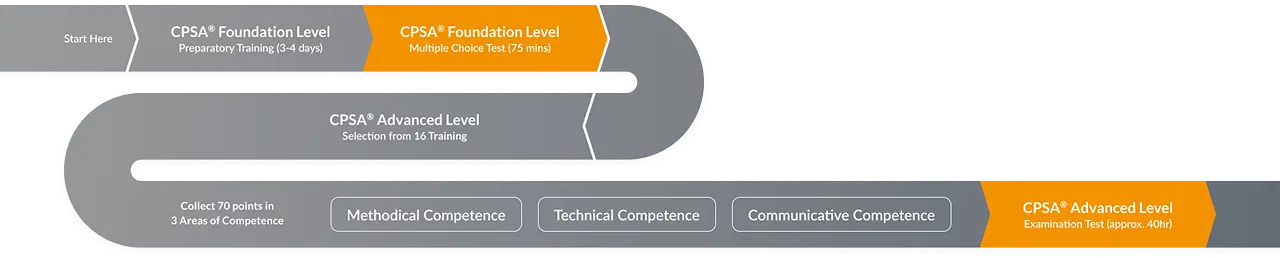
The iSAQB® CPSA Advanced Level (CPSA-A®) is the next step after the CPSA Foundation Level. It uses a modular program where candidates earn credit points through Advanced Level module trainings across three competence areas: methodology, technology, and communication. It targets experienced software architecture professionals and expects strong practical experience, since it requires candidates to demonstrate comprehensive knowledge and skills. To register for the CPSA-A® exam, you need at least 70 credit points, with at least 10 in each competence area.

The Advanced Level goes deeper and is modular. iSAQB describes three competence areas and “flexible pathways” through the program, so people can focus on what fits their work. The Advanced Level also requires that you already have the Foundation Level.

Certification

iSAQB Certification Process

1. Start with CPSA-F (Foundation Level)

  • CPSA-F is the first mandatory step for everyone.

  • You attend a Foundation training course, where you learn core architecture concepts, roles, quality attributes, documentation, and design methods.

  • After the training, you take the Foundation exam (multiple-choice).

  • When you pass, you receive the CPSA-F certificate, which proves your basic knowledge and makes you eligible for the Advanced path.

2. Move to CPSA-A (Advanced Level)

To qualify for the Advanced Level, you must meet three requirements:

  1. Hold a CPSA-F certificate

  2. Have at least 3 years of IT experience (including involvement in design or development of two systems)

  3. Collect 70 credit points by attending iSAQB-approved Advanced modules

The Advanced modules cover three competence areas:

  • Methodical competence

  • Technical competence

  • Communicative competence

You must earn at least 10 points in each area, and together they must total 70 points.

3. Take the CPSA-A Exam

Once you have your credit points and experience, you can register for the Advanced examination. The CPSA-A exam has two parts:

1. Written Architecture Assignment

  • You receive a real architecture task

  • You design a solution and document it

  • You have up to 3 months to complete it

2. Oral Defense

  • You present and defend your architecture in front of two independent examiners

If both parts pass, you receive the CPSA-A certificate.

Summary in One Line

CPSA-F exam → collect 70 credit points (min 10 points for each area) → CPSA-A written assignment → CPSA-A oral defense → Advanced certification

FAQs