


Bildux Logo
iSAQB® Promo

iSAQB® CPSA: Certified Professional for Software Architecture

  • 21 Trainings
  • 1 Provider

iSAQB (International Software Architecture Qualification Board) provides a structured certification path for software architects through the Certified Professional for Software Architecture (CPSA) program. It includes the CPSA-F (Foundation Level) and CPSA-A (Advanced Level), focusing on practical architecture skills, terminology, documentation, and decision-making.

On Bildux, you can compare training courses from different providers that align with iSAQB curricula, including exam preparation options and Advanced Level module coverage. This board helps individuals and HR or L&D teams identify training that fits role needs and development plans.

iSAQB® Course Catalogue

21 courses

iSAQB® CPSA-A

(Advanced Level)20 courses

iSAQB® WEBSEC - Advanced Level Certification

The iSAQB® WEBSEC training provides essential knowledge on web security and secure software architecture. Participants learn to identify common security risks and attack methods, integrate security requirements into software architectures, and implement best-practice protection measures. The training covers topics such as secure development processes, cryptography, authentication, attack detection , and defense against threats like injection attacks and man-in-the-middle attacks.

onlineonsite
4 sessions

iSAQB® WEB - Web Based Software Architecture Certification

Web presence is essential to the growth of any business. And precisely for this reason, it is fundamental for software architects to acquire the necessary skills and knowledge to develop correspondingly secure, reliable, and high-performing web-based software architectures. The iSAQB® WEB training provides you with the required knowledge and essential skills to carry out this task.

onlineonsite
5 sessions

iSAQB® SWARC4AI - Advanced Level Certification

The iSAQB Advanced Level SWARC4AI (Software Architecture for AI Systems) course teaches software architects how to design modern architectures for AI and machine learning systems. Participants learn how to integrate AI components, data pipelines, and machine learning models into scalable and maintainable software architectures. The training focuses on key topics such as AI system design, model integration, data management, and operational reliability. It also covers architectural decisions that support secure, transparent, and compliant AI solutions. After the course, participants understand how to design robust software architectures for AI-driven applications and manage the lifecycle of AI components in complex IT environments.

online
3 sessions

iSAQB® SOFT - Advanced Level Soft Skills Certification

Very few people use the full potential of soft skills. Would you also like to improve yourself in some aspects? Skills such as empathy and moderation are essential in project management because software architects and developers, and project managers are connected to other departments and have to communicate effectively.

onlineonsite
6 sessions

iSAQB® REQ4ARC - Requirements for Software Architects

The REQ4ARC module shows you how to analyze, assess, and use requirements effectively in your role as a software architect. You will learn to systematically identify, question, and prioritize functional and quality requirements and translate them into consistent architecture. The module also covers communication with stakeholders, interpreting vague or conflicting input, and handling trade-offs between competing goals.

onlineonsite
3 sessions

iSAQB® IMPROVE - Advanced Level Certification

IMPROVE training is part of the qualification for software architects within the iSAQB Advanced Level program. Participants learn to optimize software systems and architectures by using specific evaluation methods. The course focuses on balancing economic and technical targets. Professionals learn to identify technical debt and use refactoring to maintain the quality and performance of software over time.

onlineonsite
4 sessions

iSAQB® GREEN - Advanced Level Certification

The iSAQB® GREEN course trains you to develop energy-efficient software architectures that reduce CO₂ emissions. Learn how to optimize your applications with sustainable cloud technologies, implement Green IT patterns, and reduce energy consumption using modern techniques. At the end of the course, you will be able to design scalable and eco-friendly software systems.

onlineonsite
4 sessions

iSAQB® FUNAR - Functional Software Architecture Certification

The accredited iSAQB training "FUNAR" shows you functional software architecture as an alternative to object-oriented software architecture. In contrast to OO architecture, functional software architecture is based on immutable data, algebraic abstractions, and embedded domain-specific languages. The result: Flexible and robust architectures that are simpler and easier to understand than OO and contain fewer hidden dependencies.

online
2 sessions

iSAQB® FLEX - Flexible Architecture Models Certification

The focus of the Advanced Level FLEX iSAQB® training is the design of flexible architecture models. Since the requirements for modern software are changing faster and faster these days, flexible architectures are helpful . In the FLEX iSAQB® training, the software architects get to know and understand topics such as "Microservices" or "Self-contained Systems" in a pragmatic way.

online
4 sessions

iSAQB® FM

iSAQB CPSA-Advanced Level FM (Formal Methods) introduces formal methods that supplement traditional software architecture practices by using mathematical techniques to specify and verify critical system properties. Participants cover core topics such as logic , the link between specification and implementation , and how formal methods fit into the development process , supported by tools and practical examples. The course focuses on how to design architectures that are amenable to formal verification, including the implications for language and tooling choices when connecting specification and code.

No sessions yet

iSAQB® EMBEDDEDSEC

The iSAQB® EMBEDDEDSEC course trains software architects and engineers to design secure embedded systems. Through theoretical lectures and practical case studies, participants learn to identify vulnerabilities and apply security controls at the architectural level. Key topics include: Threat modeling and risk assessment Cryptography for resource-constrained devices Secure boot and firmware updates Hardware Security Modules (HSM) and Trusted Execution Environments (TEE) The training prepares professionals to meet compliance requirements for industry standards like ISO/SAE 21434 and IEC 62443 . After completion, attendees can systematically plan and implement security mechanisms within embedded software architectures.

No sessions yet

iSAQB® EMBEDDED Dependable Embedded Systems

This iSAQB module teaches software architecture for dependable embedded systems, focusing on safety, reliability, and security. Participants learn to manage hardware limits, real-time requirements, and resource constraints using fault tolerance patterns. Dependability: Safety, security, and reliability definitions. Risk Analysis: Failure identification and impact assessment. Fault Management: Detection, isolation, and recovery techniques. Hardware Interaction: Memory, power, and timing management. Compliance: Standards such as ISO 26262 and IEC 61508. As an elective for the iSAQB CPSA-A certification, this course uses technical instruction and practical examples to help architects meet regulatory standards for embedded products.

No sessions yet

iSAQB® EAM - Enterprise Architecture Management Training

The further development of a complete IT landscape differs significantly from the further development of a single IT system. In this iSAQB® training, you will get an overview of Enterprise IT Architecture Management (EAM) to bring transparency to the IT landscape and form the basis for a successful IT strategy.

online
3 sessions

iSAQB® DSL - Advanced Level Certification

The iSAQB DSL course covers the design and implementation of Domain-Specific Languages to model business rules and workflows. It teaches participants how to identify DSL use cases and integrate them into software architectures. Key Topics: Internal and external DSLs Concrete and abstract syntax Code generation and interpretation techniques Language workbenches and parser generators Build process integration and development environments Language maintenance and versioning This course is a module of the iSAQB Certified Professional for Software Architecture (CPSA) Advanced Level. It provides the t echnical skills to connect business requirements with technical implementation.

No sessions yet

iSAQB® DDD - Domain Driven Design Training

iSAQB® Domain Driven Design (DDD) is an advanced iSAQB module where you can learn to develop a language and use DDD models to connect different applications. Using the sample apps, you can learn the individual steps in DDD training in tecnovy. It is an application-oriented and high-quality software architecture.

onlineonsite
6 sessions

iSAQB® CLOUDINFRA - Advanced Level Certification

The iSAQB® CLOUDINFRA Training will familiarize you with the underlying concepts and implementation methods of dynamic cloud-native architectures . How can you operate applications reliably with containers, which methods can be used to set up a target-oriented monitoring system, how can you create a demand-oriented alerting system?

onlineonsite
7 sessions

iSAQB® ARCEVAL - Architecture Evaluation Certification

The iSAQB ARCEVAL course teaches systematic methods to evaluate software architectures. This module of the Certified Professional for Software Architecture (CPSA) Advanced Level helps professionals verify if a system meets its quality requirements. ATAM: Identifying risks and design trade-offs. Quality Models: Using ISO/IEC 25010 to define software quality. Review Techniques: Performing audits using checklists and walkthroughs. Economic Evaluation: Analyzing the cost-benefit of technical decisions. This training is for software architects and senior developers who must justify technical choices. Participants learn to document results and provide clear recommendations. Completion provides credit points toward the iSAQB CPSA-A certificate.

online
3 sessions

iSAQB® API

iSAQB® API (Application Programming Interfaces) is a CPSA-Advanced Level module that covers APIs as technical interfaces, organizational interfaces, and business-oriented building blocks. Participants learn why APIs matter, how APIs create value (including API economy concepts), and how to choose and apply API styles and technologies such as REST, GraphQL, HTTP APIs, and gRPC. The course includes practical work on API design using an outside-in approach, API descriptions, and versioning. It also addresses API lifecycle and tooling, security, and operating APIs at scale with platforms and governance.

No sessions yet

iSAQB® AGILA - Agile Software Architecture Certification

The iSAQB® AGILA module is an Advanced Level training course within the Certified Professional for Software Architecture – Advanced Level (CPSA-A) program. The course focuses on how software architecture works in agile development environments. Participants learn how to design and evolve software systems in agile teams where architectural responsibility is shared . The training shows how architects and developers make architecture decisions during short development cycles while keeping systems stable and maintainable. The course also explains how to balance architecture, speed, and quality in agile projects. Topics include collaborative design practices, continuous architecture work, and practical approaches for identifying and managing technical debt during iterative development.

onsite
1 sessions

iSAQB® ADOC - Architecture Documentation Certification

The iSAQB® Architecture Documentation (ADOC) training is an Advanced Level module within the Certified Professional for Software Architecture (CPSA-A) program. The course shows how to document software architectures in a clear and structured way so that developers, architects, and stakeholders can understand and use them in real projects. Participants learn how to create architecture documentation that supports communication, decision making, and long term system maintenance. The training uses well known methods such as arc42 , common diagram types, and clear documentation rules that are widely used in professional software architecture work. The course also explains how good documentation helps teams share knowledge, reduce misunderstandings, and keep systems maintainable as they grow. Through practical examples and exercises, participants learn how to describe architecture decisions, structure documentation, and present complex systems in a simple and consistent way.

No sessions yet

Inhouse Training

Train your entire team

Submit one request and let verified providers compete with their best offers. Compare side by side, pick the perfect fit.

Verified providersCompetitive pricingFlexible scheduling
Request Inhouse Training
Inhouse Training

iSAQB® (International Software Architecture Qualification Board)

1

iSAQB® CPSA-F(Foundation Level)

iSAQB® CPSA-F (Foundation Level)

The iSAQB CPSA-F (Foundation Level) covers the core knowledge needed to design and document software architectures for systems up to a medium size. It focuses on basic architecture concepts, requirements and constraints, design and development, specification and communication, and analysis and assessment. This level is aimed at developers and aspiring architects who want a shared vocabulary and practical methods for architecture work in a team, including quality evaluation and the use of common tools. Prior software development experience is recommended.

CPSA-F is the entry level of the iSAQB Certified Professional for Software Architecture program. The Foundation Level curriculum covers the core knowledge many software architects use in day-to-day work, including:

  • Basic concepts of software architecture, including the role and tasks of software architects

  • Requirements and constraints as a basis for architectural work

  • Design and development of software architectures, especially for small to medium-sized systems

  • Specification and communication, including describing and documenting architectures

  • Analysis and assessment, including architecture and quality evaluation

  • Examples of software architectures

2

iSAQB® CPSA-A (Advanced Level)

iSAQB® CPSA-A  (Advanced Level)

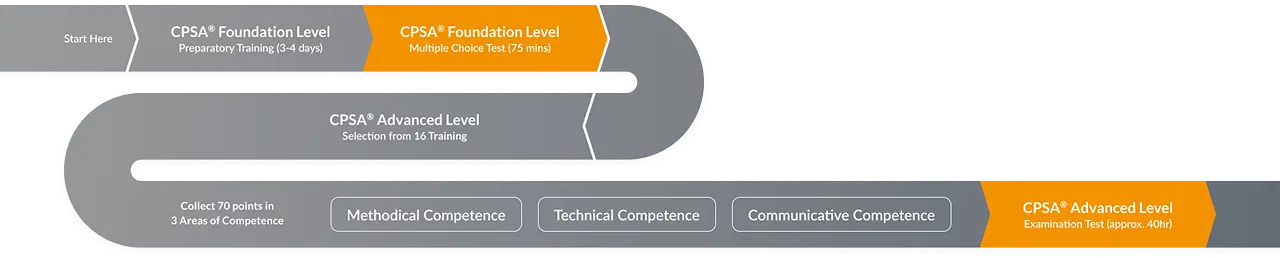
The iSAQB® CPSA Advanced Level (CPSA-A®) is the next step after the CPSA Foundation Level. It uses a modular program where candidates earn credit points through Advanced Level module trainings across three competence areas: methodology, technology, and communication. It targets experienced software architecture professionals and expects strong practical experience, since it requires candidates to demonstrate comprehensive knowledge and skills. To register for the CPSA-A® exam, you need at least 70 credit points, with at least 10 in each competence area.

The Advanced Level goes deeper and is modular. iSAQB describes three competence areas and “flexible pathways” through the program, so people can focus on what fits their work. The Advanced Level also requires that you already have the Foundation Level.

Certification

iSAQB Certification Process

1. Start with CPSA-F (Foundation Level)

  • CPSA-F is the first mandatory step for everyone.

  • You attend a Foundation training course, where you learn core architecture concepts, roles, quality attributes, documentation, and design methods.

  • After the training, you take the Foundation exam (multiple-choice).

  • When you pass, you receive the CPSA-F certificate, which proves your basic knowledge and makes you eligible for the Advanced path.

2. Move to CPSA-A (Advanced Level)

To qualify for the Advanced Level, you must meet three requirements:

  1. Hold a CPSA-F certificate

  2. Have at least 3 years of IT experience (including involvement in design or development of two systems)

  3. Collect 70 credit points by attending iSAQB-approved Advanced modules

The Advanced modules cover three competence areas:

  • Methodical competence

  • Technical competence

  • Communicative competence

You must earn at least 10 points in each area, and together they must total 70 points.

3. Take the CPSA-A Exam

Once you have your credit points and experience, you can register for the Advanced examination. The CPSA-A exam has two parts:

1. Written Architecture Assignment

  • You receive a real architecture task

  • You design a solution and document it

  • You have up to 3 months to complete it

2. Oral Defense

  • You present and defend your architecture in front of two independent examiners

If both parts pass, you receive the CPSA-A certificate.

Summary in One Line

CPSA-F exam → collect 70 credit points (min 10 points for each area) → CPSA-A written assignment → CPSA-A oral defense → Advanced certification

FAQs