
One agile team feels simple.
A small group plans the work, builds the product, tests the result, and improves step by step.
But growing companies often work with many teams. These teams share products, systems, release plans, architecture choices, customer needs, and business goals.
One team might move fast. The bigger challenge starts when many teams need to move in the same direction.
SAFe helps with that.
SAFe gives larger organizations a shared way to connect agile teams with product work, planning, architecture, DevOps, leadership, and portfolio decisions. Teams get a clear structure for planning, working, and delivering together.
This article explains what SAFe means, who SAFe suits, and which SAFe course matches different roles. For the full list of SAFe courses, levels, exam details, and training options, visit the SAFe board page on BilduX.
What Is SAFe?
SAFe stands for Scaled Agile Framework.
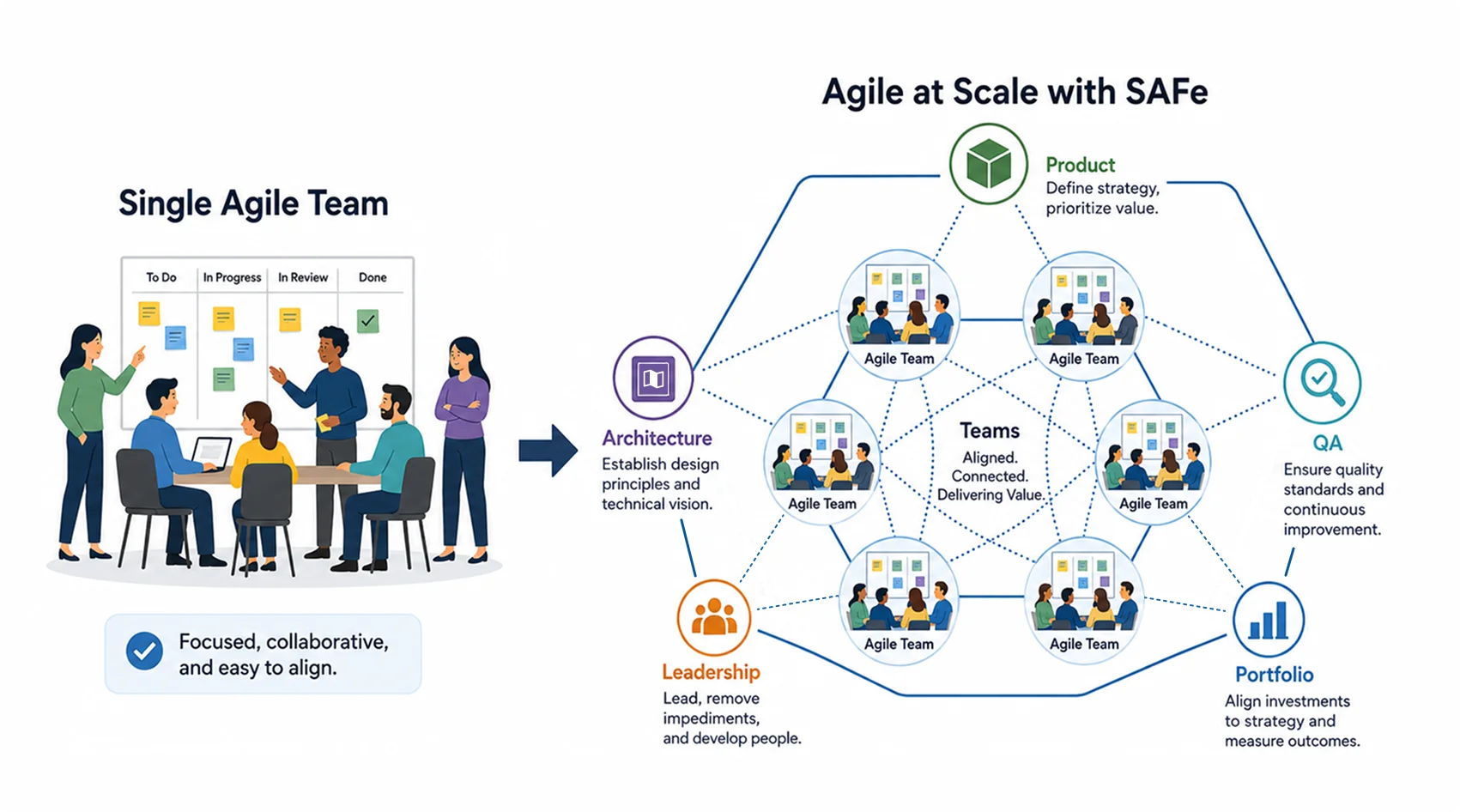
SAFe helps you coordinate agile work when growth goes beyond one team.
You use SAFe when agile work grows beyond one team. A single Scrum team is easy to manage, but things get harder when several teams work on the same product, system, or business goal.
SAFe brings those teams together.
It connects daily team work with planning, product goals, architecture, DevOps, and portfolio decisions. So instead of each team moving in its own direction, everyone works with a shared plan.
The idea is simple.
SAFe helps many agile teams work toward the same goals while keeping the bigger picture in view.
Why Do Companies Use SAFe?
Companies often turn to SAFe when the work becomes too big for one team.
This usually happens when several teams work on the same product, platform, or service. It also happens when teams depend on each other to release something useful for customers.
Without a shared structure, things get messy fast. Teams move in different directions. Planning takes more effort. Dependencies slip through. Product goals become unclear.
SAFe gives companies a way to bring all of this together.
Companies use SAFe when they need to:
align several teams around shared goals
plan work across products and releases
manage dependencies between teams
connect product work with business strategy
link portfolio decisions with delivery work
make progress easier to see
improve flow across a larger system
SAFe does not help because it makes agile “bigger.”
It helps when many teams need one shared way to plan, work, and deliver together.
Who Is SAFe For?
SAFe courses match different work roles. So the right course depends on what you do each day, how much responsibility you have, and how closely you work with other teams.
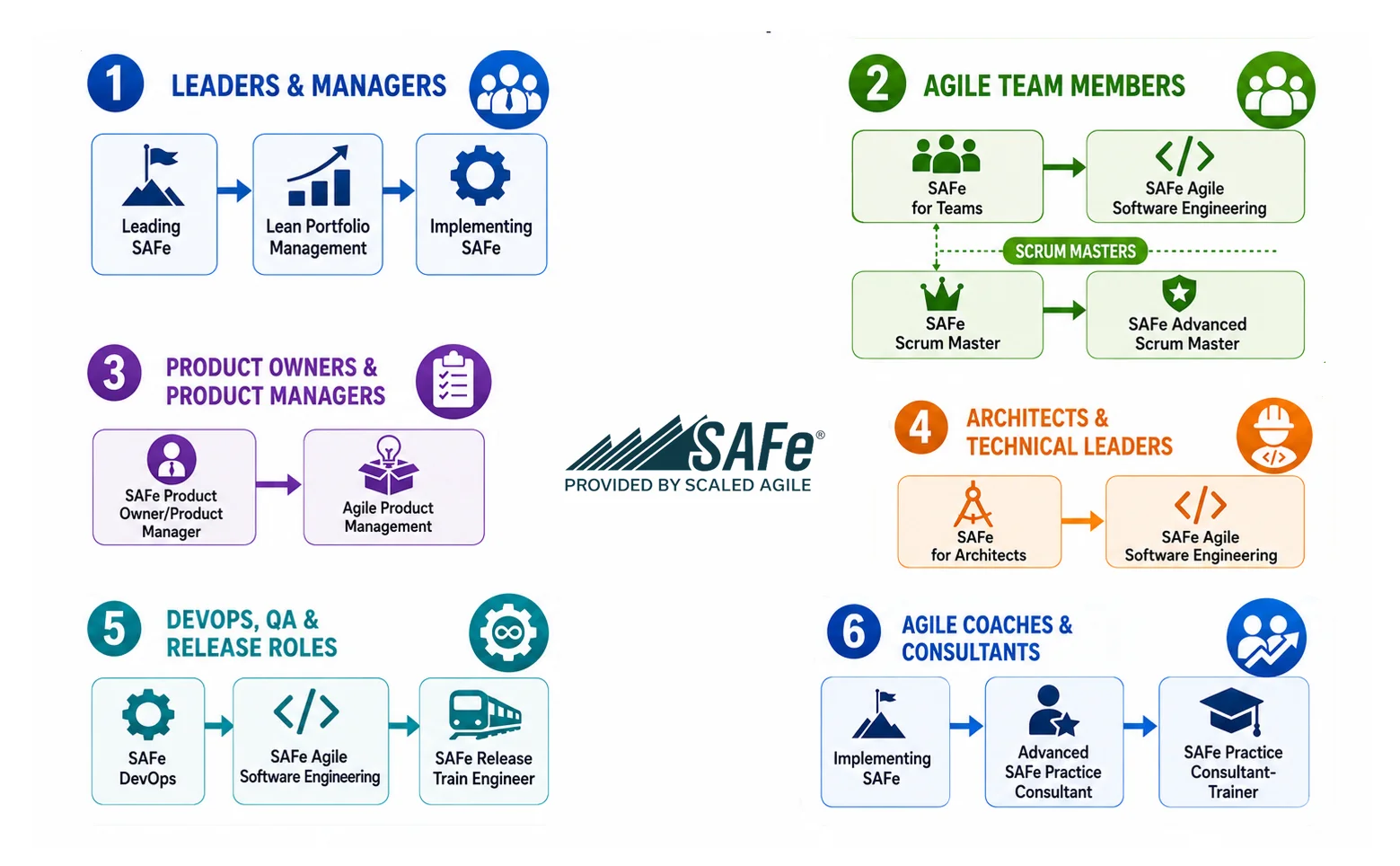
1- Leaders and Managers
Leaders often need SAFe when they want to connect strategy, funding, planning, and delivery.
They do not need every small team detail. But they need to understand how team work supports business goals.
Good course directions:
Implementing SAFe, for people who help lead SAFe adoption
2- Agile Team Members
Team members often need SAFe when their team belongs to a larger group of teams.
In SAFe, this group is called an Agile Release Train. Teams plan together, share goals, and deliver work as one larger system.
Good course directions:
SAFe Agile Software Engineering, for technical team members
Scrum Masters and Team Coaches
Scrum Masters need SAFe when they work in a larger agile setup.
The role still stays close to the team. But it also links to PI Planning, team flow, dependencies, and work across several teams.
Good course directions:
SAFe Advanced Scrum Master, for people with more experience
3- Product Owners and Product Managers
Product roles in SAFe work with backlogs, features, customer needs, roadmaps, and PI Planning.
They help teams understand what to build, why it matters, and how the work supports the product goal.
Good course directions:
Agile Product Management, for people closer to product strategy
4- Architects and Technical Leaders
Architects help teams make technical choices which still work later.
In SAFe, architecture does not sit away from delivery. It supports product goals and helps many teams build on the same technical base.
Good course directions:
5- DevOps, QA, and Release Roles
SAFe also fits people who work with quality, releases, DevOps, and delivery flow.
These roles need to understand how work moves from an idea to a real release.
Good course directions:
SAFe Release Train Engineer, for train-level work
6- Agile Coaches and Consultants
Coaches and consultants often need deeper SAFe knowledge.
They help teams, leaders, and companies change how they plan, work, and deliver.
Good course directions:
Advanced SAFe Practice Consultant, for senior trainers and consultants
How SAFe Courses Are Organized
SAFe courses are grouped by level and by role.
You do not need to take every course. You need the one that fits your current work, your next role, or the kind of responsibility you want to take on.
Foundational SAFe Courses
Foundational courses are often the best place to start.
They help you understand the main SAFe terms, roles, events, and planning ideas. They also give you a clearer view of how teams work together in a larger agile setup.
Examples include:
Leading SAFe
Leading SAFe for Government
SAFe for Teams
SAFe for Hardware
SAFe for Hardware Teams
SAFe Agile Software Engineering
SAFe Scrum Master
SAFe Product Owner/Product Manager
These courses fit people who are new to SAFe or need SAFe knowledge for their current role.
Advanced SAFe Courses
Advanced courses fit people who already work with agile teams, products, architecture, DevOps, portfolio work, or delivery planning.
They are more useful when your role involves several teams, wider planning, or more ownership.
Examples include:
SAFe DevOps
SAFe Release Train Engineer
SAFe Lean Portfolio Management
Agile Product Management
SAFe for Architects
SAFe Advanced Scrum Master
Implementing SAFe
These courses help when you need to work across teams, support planning, manage dependencies, or guide delivery at a larger scale.
Expert SAFe Courses
Expert courses are for senior SAFe professionals.
They fit people who train others, support SAFe adoption, or work as senior consultants.
Examples include:
Advanced SAFe Practice Consultant
SAFe Practice Consultant-Trainer
Most learners do not begin here. These courses are better for people who already have strong SAFe experience and want to guide others with confidence.
Which SAFe Course Fits Your Role?
The best SAFe course depends on your role.
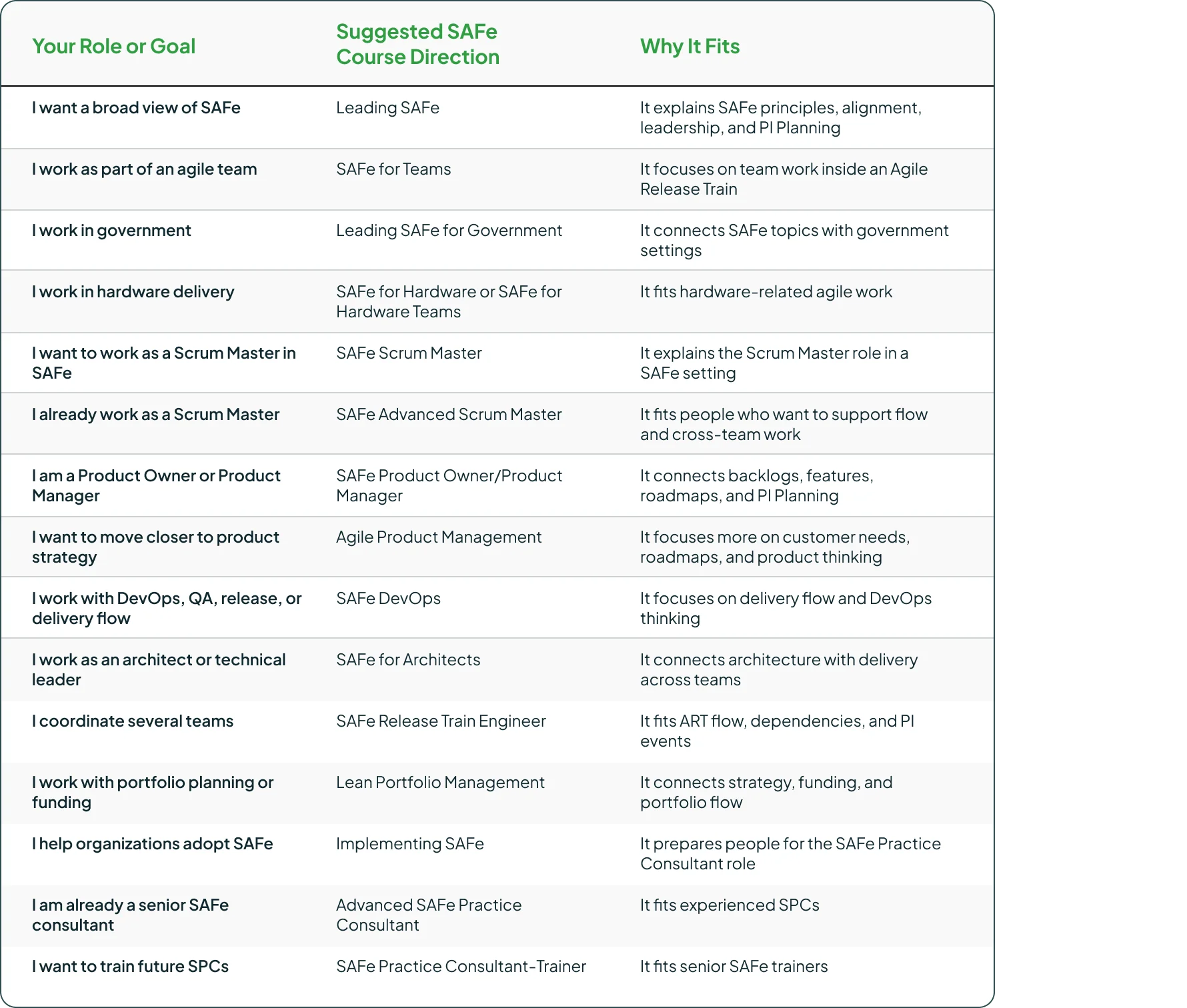
A simple rule helps here.
Start with your role, not with the course that sounds most popular.
Is SAFe Useful for Your Career?
SAFe can be useful if your company uses SAFe or plans to use it.
It helps you understand terms such as Agile Release Train, PI Planning, value streams, backlog, flow, and Lean-Agile principles.
It can also support roles in:
agile leadership
product work
Scrum Master work
architecture
DevOps
portfolio work
release coordination
agile coaching
But SAFe is not useful for everyone.
If you work in a small team that does not use scaled agile, you may not need it right now. A basic Scrum or agile course may fit better.
SAFe also does not replace real work experience. You still need to work with teams, products, planning, delivery issues, and real users.
SAFe is most useful when it matches your company setting or your next role.
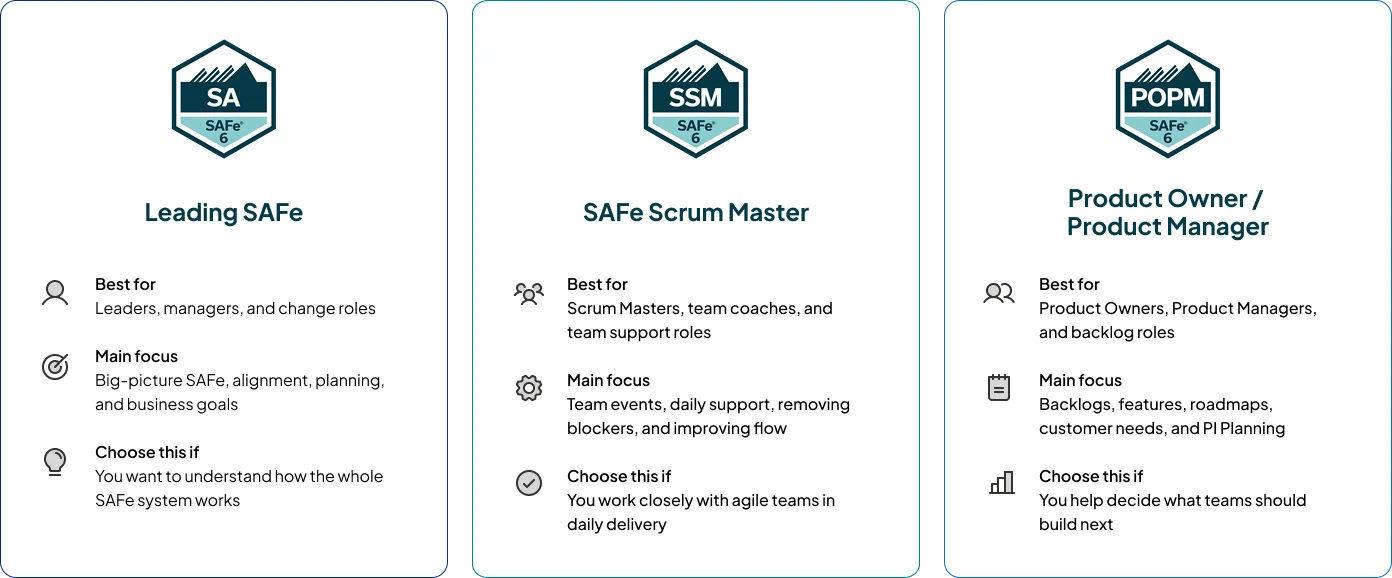
Leading SAFe, SAFe Scrum Master, or POPM?
People often compare these three SAFe courses.
At first, they sound close to each other. But each one serves a different role and gives you a different view of SAFe.
Choose Leading SAFe if...
Choose Leading SAFe when you want the bigger view.
This course works well for leaders, managers, agile change roles, and people who need to understand how SAFe connects teams, planning, and business goals.
It is often a strong first SAFe course for anyone who needs to see how the whole system works.
Choose SAFe Scrum Master if...
Choose SAFe Scrum Master when you support agile teams in their daily work.
This course fits Scrum Masters, team coaches, and people who help teams plan work, run events, remove blockers, and improve team flow.
It stays closer to team-level work and helps you understand your role inside a larger SAFe setup.
Choose SAFe Product Owner/Product Manager if...
Choose POPM when your work sits close to product decisions.
This course fits Product Owners, Product Managers, and people who manage backlogs, features, roadmaps, and customer needs.
It is also useful when your work connects to PI Planning, value delivery, and helping teams understand what to build next.A simple rule helps here.
Start with your role, not with the course that sounds most popular.
Is SAFe Useful for Your Career?
SAFe can be useful if your company uses SAFe or plans to use it.
It helps you understand terms such as Agile Release Train, PI Planning, value streams, backlog, flow, and Lean-Agile principles.
It can also support roles in:
agile leadership
product work
Scrum Master work
architecture
DevOps
portfolio work
release coordination
agile coaching
But SAFe is not useful for everyone.
If you work in a small team that does not use scaled agile, you may not need it right now. A basic Scrum or agile course may fit better.
SAFe also does not replace real work experience. You still need to work with teams, products, planning, delivery issues, and real users.
SAFe is most useful when it matches your company setting or your next role.
Leading SAFe, SAFe Scrum Master, or POPM?
People often compare these three SAFe courses.
At first, they sound close to each other. But each one serves a different role and gives you a different view of SAFe.
Choose Leading SAFe if...
Choose Leading SAFe when you want the bigger view.
This course works well for leaders, managers, agile change roles, and people who need to understand how SAFe connects teams, planning, and business goals.
It is often a strong first SAFe course for anyone who needs to see how the whole system works.
Choose SAFe Scrum Master if...
Choose SAFe Scrum Master when you support agile teams in their daily work.
This course fits Scrum Masters, team coaches, and people who help teams plan work, run events, remove blockers, and improve team flow.
It stays closer to team-level work and helps you understand your role inside a larger SAFe setup.
Choose SAFe Product Owner/Product Manager if...
Choose POPM when your work sits close to product decisions.
This course fits Product Owners, Product Managers, and people who manage backlogs, features, roadmaps, and customer needs.
It is also useful when your work connects to PI Planning, value delivery, and helping teams understand what to build next.
POPM or Agile Product Management?
POPM sits closer to daily product work in SAFe.
It focuses on Product Owner and Product Manager tasks, backlogs, features, PI Planning, and delivery. This course fits you well when you work close to teams and help turn product needs into planned work.
Agile Product Management has a stronger focus on product strategy.
It looks more at customer needs, product thinking, roadmaps, and product leadership. This course fits you better when you already work in product and want to build a stronger strategic view.
Choose POPM if your work is close to teams, backlogs, and delivery.
Choose Agile Product Management if your work is closer to product direction, customer problems, and long-term product decisions.
SAFe Scrum Master or SAFe Advanced Scrum Master?
SAFe Scrum Master is the starting point for Scrum Master work in SAFe.
This course fits people who want to understand the role, support agile teams, and learn how Scrum Master work changes in a SAFe setup.
SAFe Advanced Scrum Master is for people with more experience.
This course fits Scrum Masters who already know the basics and want to improve team flow, support better results, and work more across teams.
Choose SAFe Scrum Master when you are new to the role or new to SAFe.
Choose SAFe Advanced Scrum Master when you already have Scrum Master experience and want to take the next step.
SAFe for Teams or Leading SAFe?
SAFe for Teams is made for people who work inside an Agile Release Train.
The course stays close to daily team work, team events, iteration work, and PI Planning. It helps team members understand how their work connects with other teams.
Leading SAFe gives you a wider view.
This course fits leaders, managers, and people who need to understand SAFe across teams, products, planning, and business goals.
Choose SAFe for Teams when you mainly work as part of a team.
Choose Leading SAFe when you need the bigger SAFe view and want to understand how the full system works.
Top 5 Questions About SAFe
1- Which SAFe course should I start with?
Many people start with Leading SAFe because it gives a broad view.
Team members may choose SAFe for Teams. Scrum Masters may choose SAFe Scrum Master. Product roles may choose POPM.
2- Is SAFe useful if my company does not use SAFe?
It can still help you understand scaled agile language.
But it is most useful when your company uses SAFe or plans to use it.
3- Should I choose SAFe Scrum Master or POPM?
Choose SAFe Scrum Master if you support teams and Scrum Master work.
Choose POPM if you work with backlogs, features, roadmaps, and product delivery.
4- What is the difference between POPM and Agile Product Management?
POPM is closer to backlog and delivery work in SAFe.
Agile Product Management is closer to product strategy, customer needs, roadmaps, and product leadership.
5- Does SAFe certification expire?
SAFe certifications need renewal.
Check the current Scaled Agile renewal rules before relying on an older certificate.